
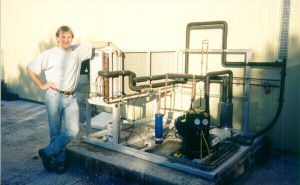
 Rustin Cooper IEng MCIBSE M.Inst.R MEI - Managing Director, Coopertec Systems Ltd
How did you get into a career in energy and sustainability?
My route into energy and sustainability started with refrigeration engineering. I followed relatives into the refrigeration industry after studying mechanical engineering and joined the family business. This was in the 1990s, and I was designing, installing and commissioning refrigeration systems for the fresh produce sector, including process cooling and cold storage applications.
Surprisingly, the basic engineering principles have not changed a great deal since then, although we have seen developments such as the increasing use of CO₂ as a refrigerant and more sophisticated control techniques. It was a very practical hand on introduction to engineering, and we worked on projects around the world. I’ve always said engineering and art are closer linked than many perceive. As engineers, we are constantly challenged with finding solutions that often require creativity and lateral thinking.
When did energy and carbon start to become a bigger part of your work?
Energy became a much bigger part of the conversation perhaps 10 to 15 years ago, when carbon reporting and corporate sustainability started becoming increasingly important to clients. Suddenly, the business case for improving a refrigeration system had another dimension. We were considering not only the financial aspects, but also the carbon impact and how a project contributed towards an organisation’s wider sustainability strategy.
Around 10 years ago, I was also fortunate to undertake an assignment with the Marks & Spencer engineering team, which gave me exposure to a different style of operation and to energy management across a large estate. That developing interest in energy led naturally into areas such as ESOS, TM44 and SECR. I qualified as an ESOS Lead Assessor in 2018. For me, ESOS complemented the engineering work we were already doing rather than being a completely separate discipline.
Are there other areas of energy management that particularly interest you?
Advancements in Grid’s ‘Demand Flexibility Service’ (DFS) is another area that has interested me. I project managed a major DFS project in 2017. It is not necessarily an energy-saving measure in itself, but managing when energy is consumed can add another financial dimension to an energy project. With increasing levels of intermittent renewable generation on the electricity system, flexibility and demand management are likely to remain increasingly relevant.
How did you become involved with ESOS?
My involvement with ESOS grew from that combination of engineering, refrigeration and energy-management work. Although process cooling remains an important area of expertise for me, my ESOS work is much broader. I have undertaken assignments across food processing, drinks manufacturing, pharmaceuticals, leisure facilities, offices and even zoos. That variety is useful because ESOS requires you to look beyond one particular technology. On a food manufacturing site, for example, refrigeration might be one of the largest electrical loads, but compressed air, steam generation, process heating, ventilation and fluid pumping can all be significant energy consumers as well.
What are some of the biggest practical challenges when carrying out an ESOS assessment?
One of the biggest lessons from delivering ESOS is the importance of good-quality data. At the beginning of an assessment, you do not always know whether you are going to receive a clean, verifiable data set that can be analysed relatively quickly, or a complicated paper trail requiring days of work simply to establish how much energy the organisation has consumed and where. Access to good data can therefore make an enormous difference to both the quality and efficiency of an ESOS assessment. This is also why I think a good energy-management system is so valuable. Businesses need clear, accessible information that allows them to see what is happening rather than simply receiving a utility bill several weeks later. Good visualisation and appropriate sub-metering help turn data into something that operational teams can actually use.
Do you think ESOS itself has improved?
I think it has. Public accountability and the introduction of action plans have encouraged organisations to think more seriously about what happens after the audit rather than treating compliance as the end of the exercise. Energy-intensity measures are useful as well, although I think there is an opportunity in future to develop more standardised sector benchmarks. If anonymised ESOS data could eventually help establish meaningful norms for particular industries or processes, organisations could better understand how their performance compares with similar operations.
 Based on your experience within the refrigeration sector, what are the key energy-management challenges and where are the greatest opportunities?
My starting point is reviewing the production process and understanding how and where energy is consumed, whether that is refrigeration, steam generation, air conditioning, heating, drying or another significant process load. This is particularly important within food and drink manufacturing, pharmaceutical operations and other businesses where process cooling and heating are fundamental to production.
Where do you tend to look first for refrigeration energy savings?
Keeping condensing temperatures as low as practical is one of the simplest ways to improve refrigeration efficiency. Condensing temperature can be driven unnecessarily high by common issues such as dirty or fouled condenser coils, poor fan control, restricted airflow, poorly located equipment, incorrect refrigerant charge or restrictions within the refrigerant circuit. As condensing temperature increases, discharge pressure rises and the compressor has to work across a greater pressure ratio.
An example produced by the Institute of Refrigeration illustrates the potential scale of the effect. In one typical example, reducing the condensing temperature by 10 K improved the coefficient of performance, or COP, by approximately 37%. It is important to treat that as an illustrative example rather than a universal saving, but it demonstrates why relatively basic engineering, control and maintenance measures can have a significant impact. Savings need to be calculated in relation to capacity demands.
The same principle applies at the evaporator. Operating at an unnecessarily low evaporating temperature lowers suction pressure, increases compressor pressure ratio and reduces system efficiency. The question is therefore not simply whether the process or space is being cooled to the correct temperature, but whether the refrigeration system is operating at the highest practical evaporating temperature needed to achieve it. In practical terms, that may mean raising the suction pressure setpoint, improving evaporator airflow and heat transfer, or optimising compressor capacity control so that the system is not operating at a lower evaporating pressure than necessary.
Taken together, the objective is straightforward: keep condensing temperature as low as practical and evaporating temperature as high as practical, while still meeting the required process conditions.
Of course, there are many other system-related issues that may be evident, including moisture ingress, poor oil return, restricted filters or strainers, poor expansion-valve control, excessive superheat, liquid flood back and compressor short-cycling. In low-temperature ammonia systems, air can also be drawn into the system when operating below atmospheric pressure, becoming trapped within the circuit and impacting system performance.
How important are controls and monitoring?
Control strategy is another major opportunity. Floating head-pressure control, appropriate suction-pressure optimisation, defrost control and good compressor sequencing can allow a refrigeration system to respond to actual conditions rather than operating continuously at conservative fixed set-points.
Monitoring is critical here. Without good data, poorly performing plant can remain unnoticed for a surprisingly long time. Trend data can identify compressors operating when they should not be, inappropriate sequencing, excessive temperature lift and equipment that has gradually drifted away from its intended operating condition.
What opportunities do you see around waste heat?
One of the biggest opportunities I repeatedly encounter is waste heat. Refrigeration systems reject considerable quantities of heat through their condensers. Historically, much of that energy has simply been discharged to atmosphere. Increasingly, we should be asking whether that heat can be captured and used elsewhere on the site.
Adiabatic cooling can also form part of the solution, helping systems operate effectively during high ambient conditions such as those experienced during the summer of 2026, while appropriate system design can create opportunities to make use of rejected heat. Modern heat-pump technology makes this particularly interesting. Even relatively low-grade warm water can provide an effective source for a heat pump, which can then raise the temperature to something useful elsewhere in the process.
Can you give a practical example?
A particularly good example is cleaning in place, or CIP, in food production.
At the end of production, equipment often needs to be washed down using water at a specified high temperature (say around 85oC) for hygiene reasons. Traditionally, that water may be heated using steam generated from fossil fuels. Once used, a significant quantity of still-warm but contaminated water then goes straight to drain. That immediately raises the question: why throw that heat away?
The difficulty is contamination. Conventional plate heat exchangers can rapidly become blocked or fouled when dealing with dirty process water.
I have therefore worked on an approach using an obstruction-free heat exchanger intended to extract heat from contaminated warm water. That recovered energy can then provide the source for a heat pump and be returned to a useful process.
We are installing a similar principle on a swimming-pool application. Pool backwash water is still warm when it is discharged, but contains sand and other contamination. Ordinarily, that energy disappears down the drain. Recovering heat from that water and returning it to the pool creates an opportunity to reduce the amount of fossil-fuel energy required for heating. Early indications on that project suggest a payback in the region of three years, although final performance will depend on the completed installation and operating conditions.
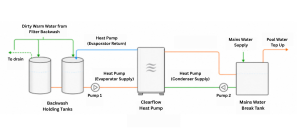
Fig 1. Recovering heat from contaminated backwash water (Swimming Pools)
This illustrates an important point about decarbonisation. Sometimes the barrier is not the availability of heat. There may be enormous quantities of waste heat on a site. The challenge is finding a technically practical way of capturing it, upgrading it and matching it to a useful demand.
What about processes that need higher temperatures traditionally provided by steam?
Higher-temperature heat pumps are expanding those opportunities further. Mechanical vapour recompression, or MVR, is another technology worth considering where appropriate because it can recover and recompress process vapour to produce useful higher-temperature heat. In suitable applications, technologies such as MVR and high-temperature heat pumps can eliminate the requirement for fossil-fuel steam boilers.
How significant is refrigerant choice when considering carbon reduction?
There is also an important refrigerant dimension to carbon management. The refrigeration industry is progressively moving towards natural refrigerants such as ammonia, carbon dioxide and hydrocarbons such as propane and isobutane. When considering the carbon impact of a refrigeration system, organisations should look not only at the electricity consumed by the plant but also at refrigerant choice, leakage impact and the longer-term environmental implications of the refrigerants being specified.
I am cautious about simply moving from one generation of synthetic refrigerants to another without considering the full environmental picture. In particular, there is increasing scrutiny around HFO refrigerants, including concerns relating to PFAS and so-called “forever chemicals”. Refrigerant selection is a long-term engineering decision, and environmental and regulatory horizon scanning should therefore be part of that decision.
Outside refrigeration, where else do ESOS assessments commonly uncover opportunities?
I regularly find significant opportunities in compressed air management, steam generation, pumping, ventilation, process heating and of course in BMS controls set up. Surprisingly VSD applications are still being found.
What are the main barriers to actually implementing the opportunities you identify?
The biggest barriers are often not technical. Capital availability is obviously important, but operational risk can be just as significant. Production teams understandably do not want an energy project to interfere with product quality, hygiene, safety or output.
This is why evidence matters. Good monitoring, a clear baseline and a credible business case help turn an energy-saving idea into an investable project.
It is also useful to think beyond energy savings alone. Carbon reduction, maintenance benefits, improved resilience and, in some cases, Demand Flexibility Services can all strengthen a business case.
The projects that get implemented first are still generally those with the fastest paybacks. The challenge for energy managers and ESOS Lead Assessors is therefore to identify the quick wins while also creating a credible pathway for the more strategic projects that may deliver much larger long-term reductions.
How are you and your clients preparing for the ESOS Phase 4 compliance deadline?
 I have already contacted clients, issued reminders and prepared proposals for Phase 4 work.
Some sectors and organisations are starting early, but many are still waiting. That is frustrating because we see the same cycle every four years: a relatively slow start followed by a significant rush as the deadline gets closer.
Why do you think organisations leave it so late?
Budget is one of the main reasons. Some organisations have simply not included ESOS within the current year’s budget, despite knowing that the compliance requirement is approaching.
My advice is not to wait until everything is perfectly aligned before starting.
I have suggested to some clients that they authorise the work initially through a simple letter of intent so that we can begin the site audits. The audits are one of the most time-consuming and practically demanding parts of the process. If those can be completed early, some of the subsequent analysis and reporting can follow when the next budget period becomes available.
Uptake of that approach has so far been limited, but I still think starting early is the sensible route.
What would you say to an organisation that has not started preparing yet?
My advice is straightforward: understand your responsibilities now and appoint a Lead Assessor early enough to guide you through the process.
ESOS should be much more than an exercise in completing paperwork before a deadline. Done properly, it provides an opportunity to look systematically at where energy is being consumed, identify projects that make engineering and commercial sense and create an action plan that can deliver genuine energy and carbon reductions.